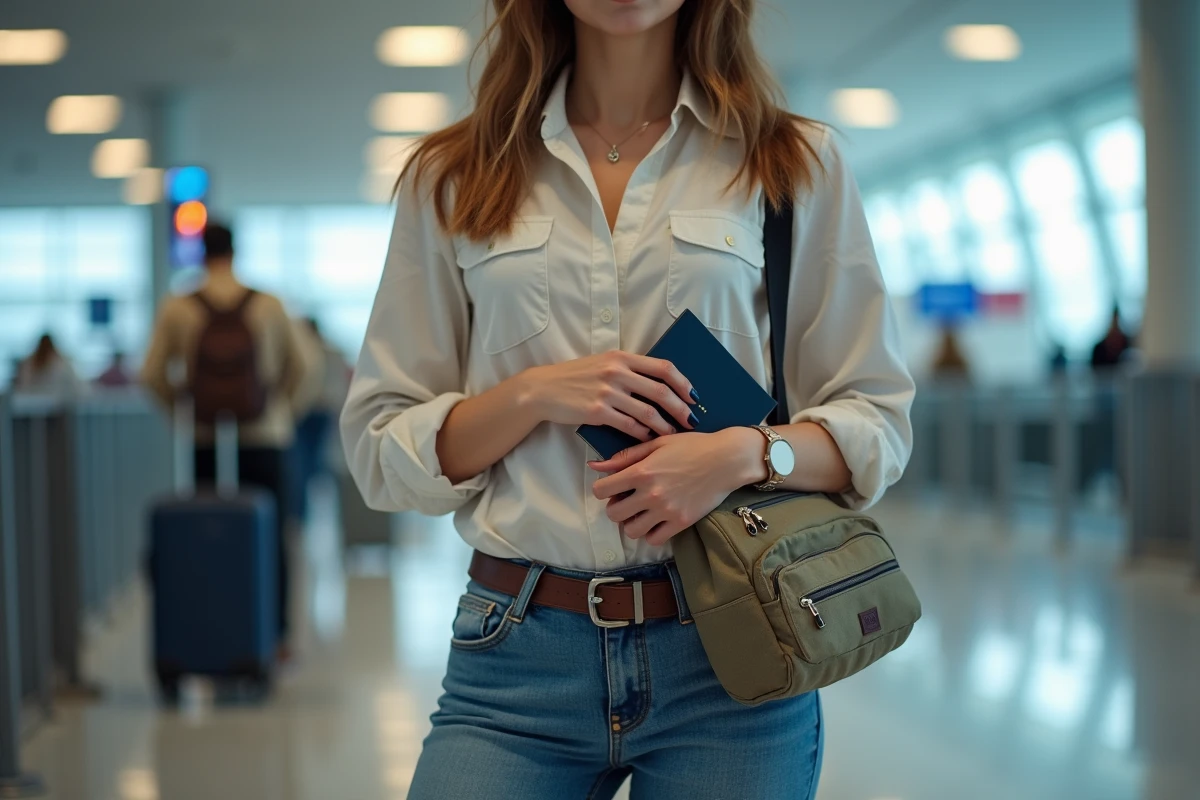
A figure emerges: 111,000 daily passengers on domestic French flights. Among them, how many carry a fanny pack without knowing if it will pass through security smoothly?
Behind the boarding queue, the question of the fanny pack still divides regular travelers. Air France requires a personal item to be neatly tucked under the seat, within precise dimensions. EasyJet, on the other hand, counts the number of items without worrying about style or shape. These subtleties turn a practical choice into an unpredictable challenge at times.
Depending on the airport or the staff on duty, tolerance varies: fanny pack accepted as a personal item, or automatically considered excess baggage. The result? Confused passengers facing inconsistent checks, or even a hefty bill at the last moment.
What the regulations say about personal items in the cabin: understanding the basics
The world of cabin baggage and personal items is fraught with complexities that few escape unscathed. Each airline imposes its own limits: maximum dimensions, maximum weight, and a precise list of permitted items. In this ambiguity, the fanny pack struggles to find a fixed place, sometimes accepted without question, sometimes deemed guilty of breaking the rules.
The principle remains simple on paper: cabin suitcase in the overhead compartment, personal item (handbag, laptop case…) stored under the seat. However, the permitted dimensions vary, rarely exceeding 40 x 30 x 15 cm. The fanny pack, lightweight and compact, almost always meets these constraints. Yet, nothing guarantees it won’t be counted as an additional bag if the official quota has already been reached.
Here are the parameters to consider before each flight:
- Cabin baggage dimensions: carefully check each airline’s limitations before packing your bag.
- Number of allowed items: most restrict to one bag and one personal item on board.
- Strictness at boarding: tightened checks when accessing the cabin, with no margin for error.
According to the regulations, nothing prevents you from taking a personal item like a fanny pack on a plane. The reality, however, plays out in front of the boarding agent. To avoid any unpleasant surprises, it’s better to anticipate the dimensions and count every item carried scrupulously. Finding yourself pulling out your credit card at the last gate has never put anyone in a good mood.
Fanny pack on a plane: accepted personal item or additional hand baggage?
At first glance, the fanny pack seems harmless. Yet, it crystallizes all regulatory nuances. Some airlines validate an accessory in addition to the main baggage, without distinction as to whether the fanny pack easily fits under the seat and remains discreet. On paper, the fanny pack passes the filter.
In practice, however, surprises await. For a few strict airlines, any additional item, whether a fanny pack, pouch, or spare bag, risks adding to the bill or causing hesitation at the boarding gate. Conversely, some agents allow the fanny pack worn at the waist, considering it simply extends the traveler’s outfit as long as no prohibited items are tucked inside.
Regular travelers share the same routine: systematically check the airline rules, ensure the fanny pack is indeed on the official list of permitted accessories, and limit anything that could resemble excess baggage. Checks become increasingly precise once the boarding line is crossed. Opting for a compact fanny pack and being reasonable about the number of items carried is still the least risky way to fly peacefully.

Practical tips and comparison of airline policies for traveling smoothly with a fanny pack
Aligning with the requirements of airlines is not a futile exercise, especially with a fanny pack. A sleek, small, well-fitted model inevitably avoids controversies at the gate. The basic criterion: being able to slide it effortlessly under the seat, and keeping it within the size limit set on the chosen airline’s website.
In France, approaches differ significantly from one airline to another. Sometimes, the fanny pack is immediately accepted as a personal item, provided no other similar item is added to the hand or shoulder. Other times, even the slightest excess, especially during peak periods or random checks, triggers a reminder of the rules, or even quick fees. Before each departure, checking the cabin baggage section of the carrier helps prevent any unpleasant surprises.
Some simple reflexes enhance the peace of mind of travelers:
- Strictly check the maximum dimensions and maximum weight allowed for each accessory.
- Store the fanny pack under the seat as soon as you enter the cabin.
- Do not tuck in any unauthorized items (non-standard liquids, bulky external batteries…).
By knowing these variations and sticking to these gestures, traveling with a fanny pack no longer feels like a lottery. It becomes a reliable and efficient tool, one that you keep within reach without drawing attention or criticism. In the face of the bustling crowd and announcements, simplicity and anticipation offer the best boarding experience.