
Truma error codes are not limited to a static list stuck in a booklet. With the arrival of the Combi D diesel, iNet X controls, and oversized lithium installations, the reading of these codes has changed. We recommend distinguishing three generations of diagnostics even before looking for an error number.
Truma error codes on Combi D and D4E diesel: what changes compared to gas
The Combi D and D4E hybrids reuse part of the historical nomenclature (E2, E16, etc.), but some classic codes now indicate failures related to the diesel circuit. An E2 on a gas Combi points to an ignition or flame fault. The same E2 on a Combi D4E can signal an air intake in the diesel line, clogging of the combustion chamber, or the presence of bubbles in the fuel circuit.
Initial feedback from D4E users on recent vans confirms the addition of suffixes (H, W) and sometimes their complete absence, depending on the associated control panel. A code displayed as “E10H” on a CP Plus will not appear the same way on an iNet X screen.
We observe that this duality creates confusion on forums: one owner of a Combi 4 gas shares their reset procedure, another applies it to a Combi D4E, and the problem persists because the cause is unrelated. Keeping the list of Truma error codes to know handy remains essential, provided it also covers diesel models.

iNet X controls and Truma touchscreen: codes that no longer look like codes
Since Truma has pushed the iNet X and Smart controls, error messages have shifted from the raw format “E…H / W…H” to textual alerts. The app or touchscreen displays an alert level (warning or blocking error) accompanied by a clear description.
The trap: some users think their device generates “new” codes, while it is the same fault presented differently. A yellow warning “Check gas supply” on the iNet X often corresponds to a classic E1 or E10. The blocking red error “Safety combustion shutdown” covers the old E2 and E3.
Mapping between iNet X alerts and historical codes
The Truma documentation does not always provide a complete mapping table. We recommend systematically noting the displayed text message AND the flashing code on the Combi case LED (if accessible), as a service technician will work with the numeric code, not with the app description.
- The warning “Low voltage” on iNet X generally corresponds to W255H on the CP Plus panel, related to a voltage drop on the 12 V network.
- The blocking error “Fan fault” refers to codes E7 or E33 depending on the model and generation of Combi.
- The message “Faulty temperature sensor” covers E16 and E17, but also some E20 on recent Combis equipped with dual circuit probes.
Error W255H and transient voltage drops on lithium installations
Error W255H has become the phantom fault of recent converted vans. Several user experiences in camper groups show a notable increase in this error after adding energy-intensive accessories: lithium battery coupled with a powerful inverter, 12 V air conditioning, large inverter.
The mechanism is as follows. When starting a power-hungry device, the voltage briefly drops below the operating threshold of the Combi (generally around 10.5 V). The Truma heater detects this micro-cut, triggers a W255H code, and stops. The battery remains generally well charged, and the user does not understand the message.
Diagnosis and solution for W255H in lithium context
The problem is not the battery capacity, but the cross-section of the power cables and the quality of the connections to the Truma case. On a factory van with a lead battery, the Combi is wired for a moderate current draw. Adding a high-power inverter on the same 12 V bus causes transient voltage drops that the Truma does not tolerate.
- Check the cross-section of the cables between the battery and the Combi: an undersized cable amplifies the voltage drop.
- Separate the power circuit of the Truma from that of the inverter or air conditioning, ideally with a direct feed from the battery.
- Inspect the terminals and connections: even a slight contact resistance is enough to trigger the code on a lithium circuit with high discharge current.
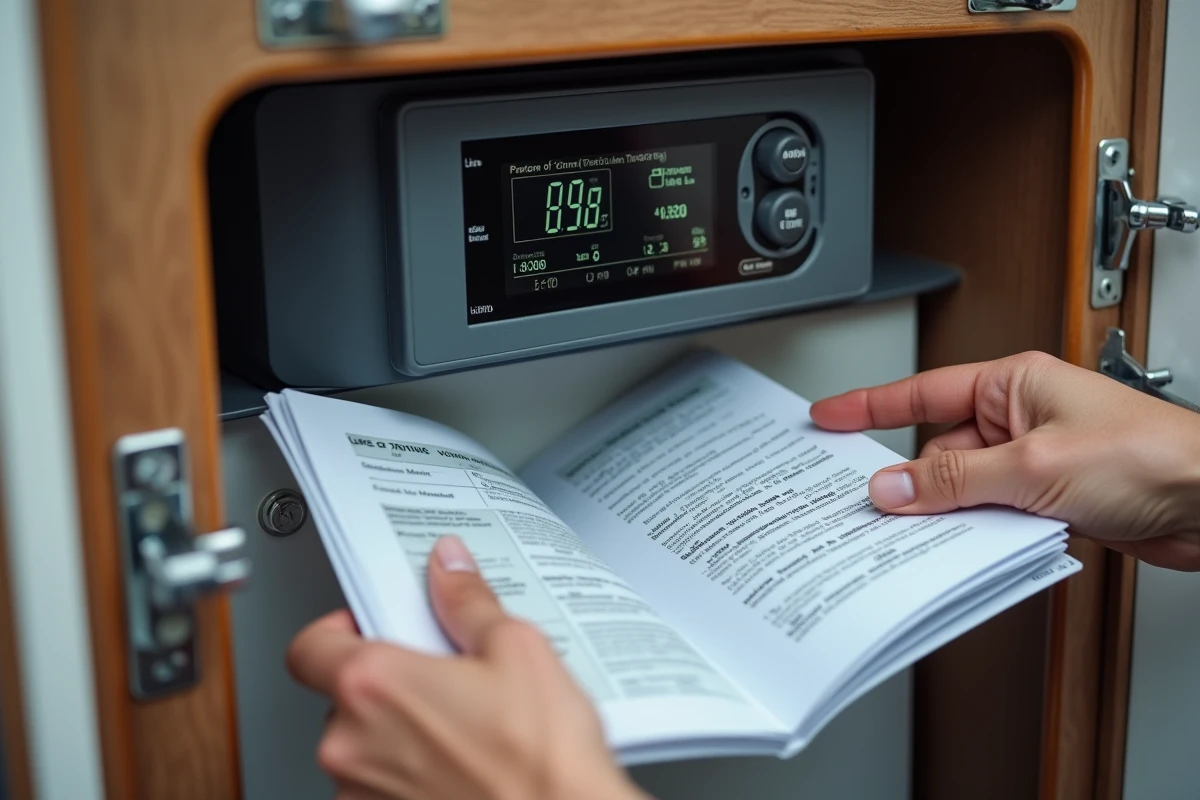
Truma reset and limits of reset on recurring errors
The classic reset (cutting off gas and electrical power, waiting a few minutes, restarting) works on most one-time errors: E1 after a bottle change, E2 after a first seasonal commissioning. A reset that “works” three times in a row masks a fault that is worsening.
On combustion errors (E2, E3), each forced restart after a safety shutdown clogs the chamber a little more. On diesel Combis, repeated resets without purging the diesel circuit can drown the injector.
When the reset is no longer enough
If the same code reappears after two consecutive resets, the diagnosis must go through a physical check: condition of the ignition electrode, cleanliness of the combustion chamber, integrity of the extraction fan. On Combi D4E, the diesel filter in line must also be inspected and air bubbles in the circuit purged.
Keeping a written record of each code with the date and conditions (outside temperature, battery level, equipment running) allows a technician to diagnose without blindly disassembling the device. A history of codes is often worth more than an hour of testing in the workshop.