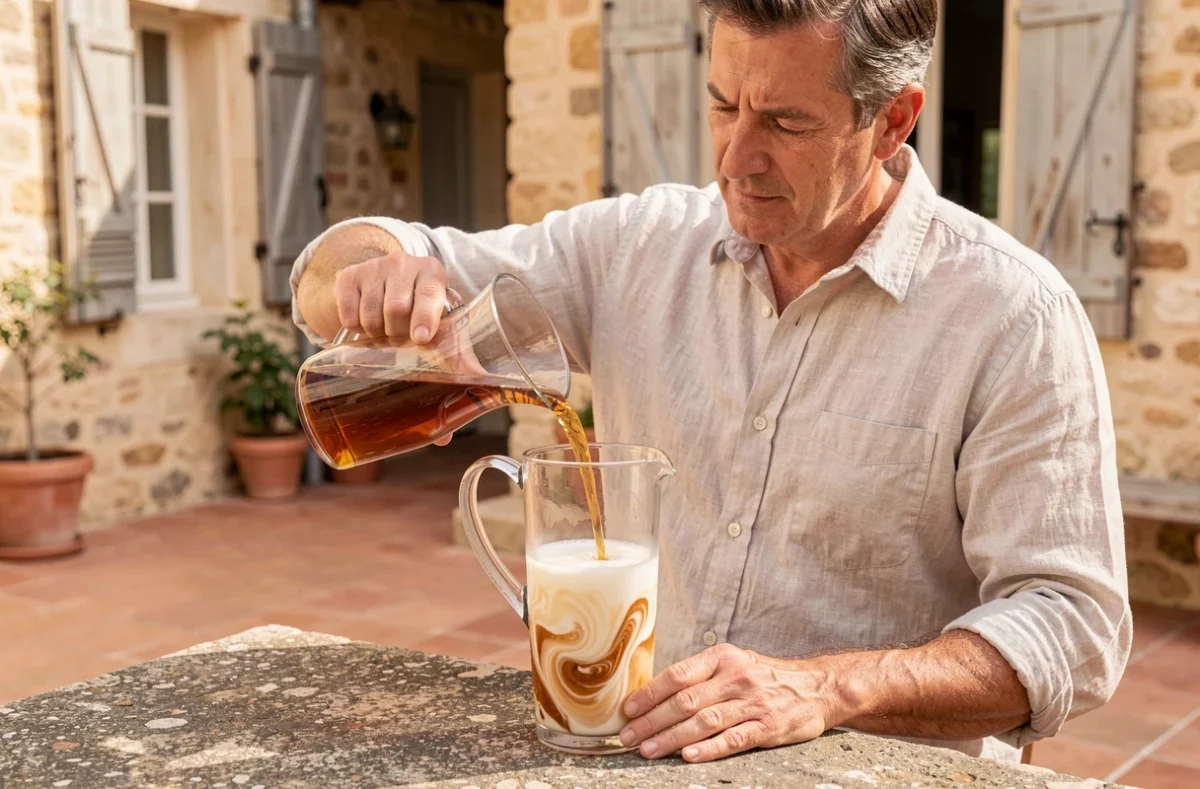
We’re preparing an aperitif for twelve people, pulling out the bottle of Ricard, and the question always arises at the same moment: how much do we pour per liter so that everyone is satisfied without emptying the stock in an hour? Between the dosage per glass, dilution with water, and the total amount to be prepared, we quickly find ourselves improvising.
Ricard has an alcohol content of 45%, which changes the game: every centiliter counts in the final result.
Why the dosage per liter depends on the alcohol content of Ricard
Most online guides simply recall the 5 to 1 rule (one volume of pastis for five volumes of water) without mentioning that this proportion is based on a specific alcohol content. Ricard has an alcohol content of 45% vol., which means that each centiliter contains more pure alcohol than a spirit at 40%.
The formula to calculate pure alcohol in a glass is simple: volume in ml × degree ÷ 100 × 0.8. With 2 cl of Ricard at 45%, you get about 7.2 g of pure alcohol, which is slightly less than a standard French glass (set at 10 g). If you pour 2.5 cl, you approach 9 g, which is nearly a standard glass.
When reasoning in terms of a liter of ready-to-drink beverage (Ricard + water), this difference accumulates glass after glass. A liter prepared with too much Ricard and not enough water increases the alcohol content of each serving without the guests realizing it, especially with melting ice that masks the taste. To delve deeper into the quantity calculations suited to your gatherings, you can visit Gourmand Sans Gluten, which details the exact proportions.
Ricard dosage per liter: the concrete calculation for a carafe
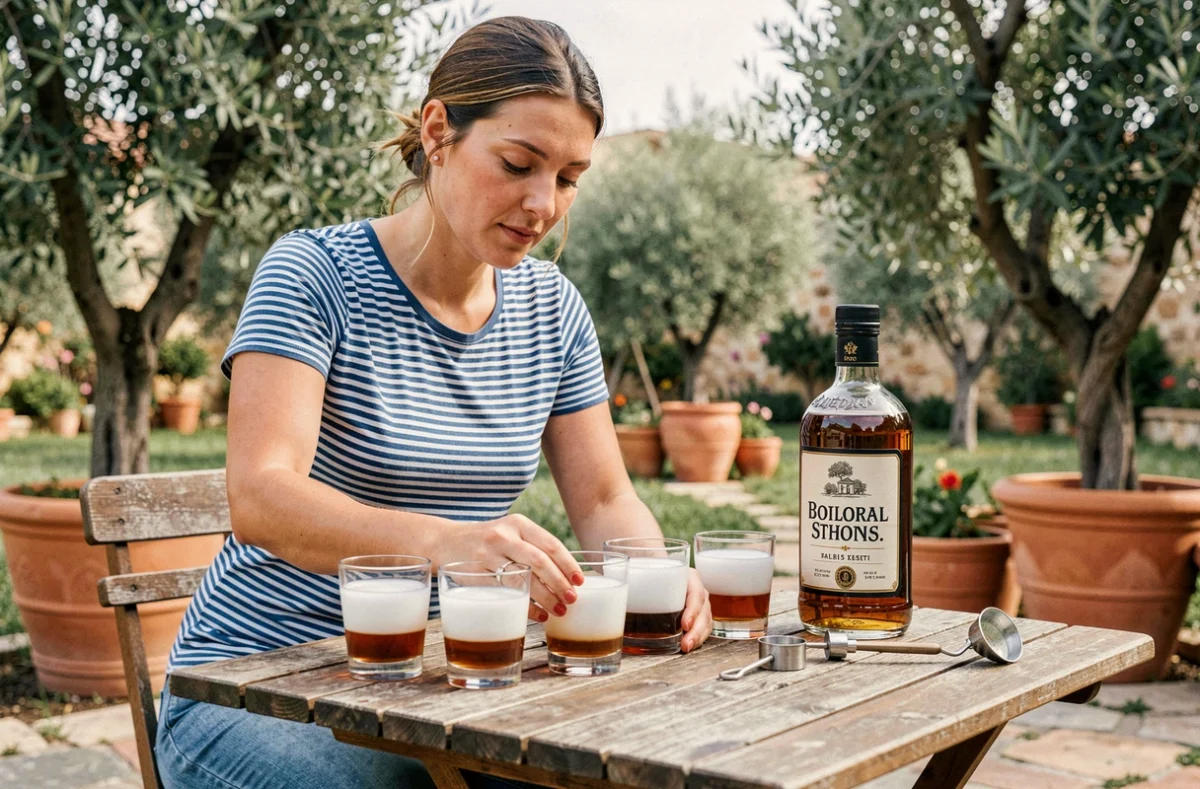
Let’s start with a classic situation: we’re preparing a one-liter carafe for the table. The reference proportion is about 17 cl of Ricard for 83 cl of fresh water. Here we find the 1 to 5 ratio applied to one liter.
With 17 cl of Ricard at 45%, the liter of mixture contains about 61 g of pure alcohol. Each 20 cl glass drawn from this carafe then represents a little more than a standard glass. You get five glasses per liter, which allows for good control over consumption.
Adjusting the proportion according to the desired intensity
Not everyone likes the same aniseed strength. Here are the three benchmarks we use in practice:
- Light dosage (1 to 7 ratio): about 12 to 13 cl of Ricard per liter of water. The anise flavor remains present but discreet, suitable for those discovering the drink or who prefer a longer aperitif.
- Classic dosage (1 to 5 ratio): 17 cl of Ricard to complete to one liter with water. This is the bar reference and the proportion that triggers the characteristic louche effect, this milky cloudiness related to the precipitation of anethole upon contact with water.
- Tight dosage (1 to 4 ratio): about 20 cl of Ricard per liter. Reserved for seasoned enthusiasts, it raises the alcohol content of each glass beyond the standard glass.
The 1 to 5 ratio remains the safest for an evening among friends because it offers the best balance between flavor and control of consumption.
Amount of Ricard bottles to prepare for an evening
We know how much to put per liter, but we also need to estimate the total number of liters for the group. The classic trap is to think in terms of bottles without considering the actual consumption rate.
Let’s take an aperitif that lasts about two hours for a group of ten people. Counting two to three 20 cl glasses per guest over this period, we arrive at a range of four to six liters of mixture. With the 1 to 5 ratio, this represents between 68 and 100 cl of pure Ricard, meaning one one-liter bottle barely covers an aperitif for ten people.
Summary table by number of guests
| Guests | Liters of mixture (2h) | Pure Ricard needed (1:5 ratio) | 1 L bottles |
|---|---|---|---|
| 5 | 2 to 3 L | 34 to 51 cl | 1 |
| 10 | 4 to 6 L | 68 cl to 1 L | 1 |
| 15 | 6 to 9 L | 1 L to 1.5 L | 2 |
| 20 | 8 to 12 L | 1.4 L to 2 L | 2 |
Feedback varies on this point: some groups consume significantly less if other drinks are offered alongside (beer, wine, soft drinks). Always allow for a margin of one-third less when Ricard is not the only option on the table.
Homemade dosage vs bar dosage: the heavy-handed trap
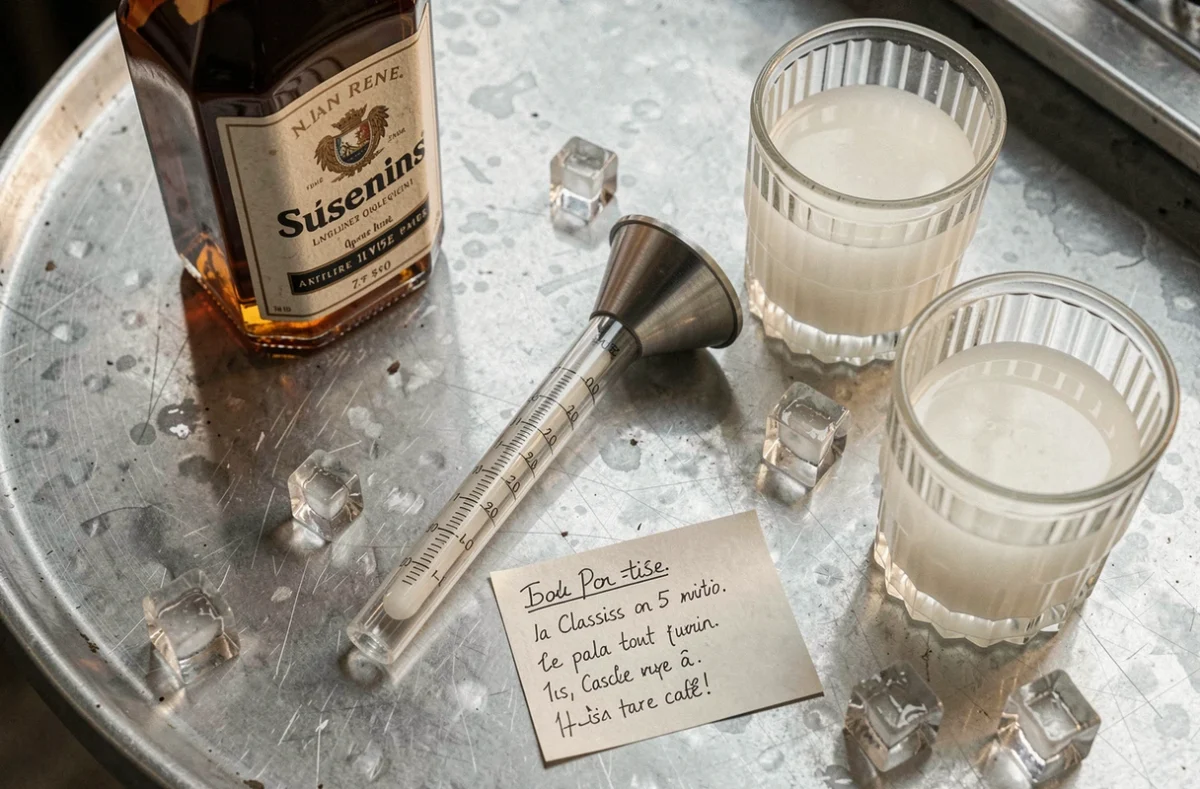
At the bar, a calibrated measure pours exactly 2 cl. At home, without a measure, we tend to pour much more than intended. This discrepancy skews the entire calculation per liter because we end up with a more concentrated mixture than we had in mind.
A graduated measuring tool is the only reliable tool to respect the ratio. Pour spouts sold for a few euros in supermarkets do the job. Without this accessory, we prepare the entire carafe rather than dosing glass by glass: we measure the 17 cl of Ricard once, top it up with water, and it’s set for the whole table.
Ice cubes and dilution: what changes (and what doesn’t)
Adding ice cubes to the glass does not remove a gram of alcohol. The gradual dilution softens the taste, which can encourage faster drinking. If we prepare the carafe in advance with very cold water, we limit the need for ice cubes and maintain a stable dosage from the first to the last glass.
- Prepare the water in the refrigerator at least two hours before serving.
- Pour the Ricard first into the carafe, then add the water (the louche effect forms better this way).
- Avoid leaving the carafe in the sun: heat accelerates the evaporation of aromas and gives a flat taste.
Public health guidelines remind us that the recommended limit is two standard glasses per day (not every day) and ten per week. With a 1 to 5 ratio and 20 cl glasses, three glasses of diluted Ricard already exceed this daily limit. Keeping the measuring tool within reach also helps keep track.